For engineering leaders & ICs
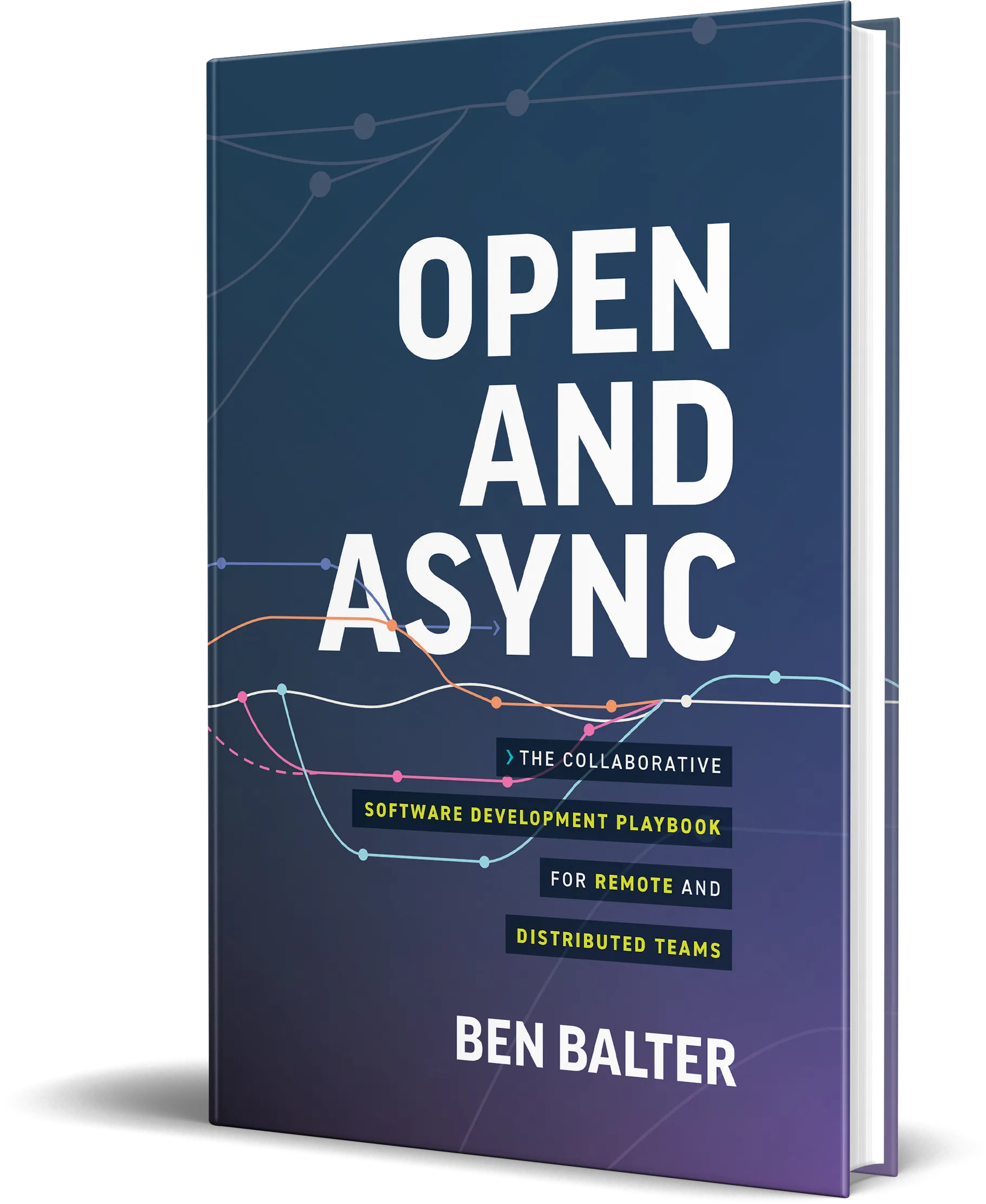
Open & Async
The collaborative software development playbook for remote and distributed teams
Working from home does not equal working remotely.
By Ben Balter — more than a decade of remote-first lessons from GitHub.
Get the ebook — US$9.99 · On Kindle, Apple Books, Kobo & more
- Yours instantly
- Ten parts, 576 pages
- Read on any device
4.9 out of 5 on Amazon.com · 10 ratings 4.5 out of 5 on Goodreads · 6 ratings
More stores and formatsShow less
Remote work isn’t failing. Your playbook is.
Your company shipped everyone a laptop, bolted Zoom onto the same approval chains, and called it remote work. It wasn’t. It was office work in sweatpants—same meetings, same status theater, same hallway politics, just piped through a webcam.
There’s a world of difference between being forced to work from home and intentionally building a distributed, async culture. This book is about that difference.
This book shows you how.
Not by recreating the office from home, but by working in the open, defaulting to async, and measuring impact over input.
Readers are recommending it
“If you are leading or wish to lead a team in such an environment, this book should be a hard prerequisite.”
“This has easily made it to my list of books that I recommend to colleagues, especially junior engineers.”

Written from inside GitHub
Ben Balter was most recently a director at GitHub, focused on helping thousands of GitHub employees do their best remote work. Before GitHub, he was a Presidential Innovation Fellow who helped draft parts of President Obama’s Digital Strategy and Open Data Policy. The U.S. Chief Technology Officer once called him one of “the baddest of the badass innovators.”
Whether you lead the team or lead the work
Either way, the problem is the same: plenty of teams are remote. Few are remote-first.
Engineering leaders
Build teams that ship quality software without constant synchronous coordination—and advance your own career in the process. Create a culture where documentation replaces hallway knowledge, transparency replaces status meetings, and your best people stay because the work respects their time.
For VPs of engineering, directors, engineering managers, and tech leads
Buying for your team?Individual contributors
When you can’t rely on hallway conversations or face time with decision-makers, your work has to speak for itself. Build your reputation through writing, async collaboration, and transparent decision-making—the skills that make you visible, effective, and promotable regardless of where you sit.
Interviewing at a remote-first company? This is the playbook they wish you’d already read.
For software developers, senior engineers, and tech leads without direct reports
Managers who read the IC chapters gain empathy for their teams. ICs who read the management chapters get a head start on their next role.
Practices, not platitudes
Six of the practices the book walks through.
Meetings as escalation
Treat meetings like production incident escalations: you don’t page the whole team before checking the logs. Start with async writing, escalate to a call only when the discussion genuinely requires higher fidelity.
Documentation as a superpower
Treat every repeat question like a piece of code: capture the answer once in concise, skimmable docs, then update or archive as needed. Cut interruptions, speed up onboarding, and stop answering the same question twice.
Working loudly
When in doubt, keep moving forward—but do it loudly. Share progress, surface risks early, and include stakeholders so nobody is blindsided. If no one objects, you’re on the right track.
Impact over input
The correlation between hours worked and value created isn’t just weak for knowledge work—it’s often inverted. Measure what people deliver rather than how long they’re online.
Leading like an engineer
You wouldn’t manage a codebase in spreadsheets and slide decks—so why manage your team that way? Issues, pull requests, and project boards aren’t just engineering tools; they’re transparency machines that make leadership decisions visible, reviewable, and searchable.
1:1s, weekly reports, and career conversations that aren’t a tax on everyone’s time
The rituals that hold remote teams together can either compound trust or quietly drain it. Run them async-first, write them down, and stop waiting for review season to have the conversations that actually matter.
Ten parts, each building on the last.
See all ten partsHide the parts
-
Foundations and definitions
Remote, distributed, open, async—what the terms actually mean and why the distinction matters.
-
The case for open and async
The business case, the personal case, and why how you work matters as much as what you work on.
-
Core principles and mental models
Parallelization, flow, impact over input, and optimizing for developer happiness.
-
Working in the open
Why everything should have a URL, documentation as a superpower, and the rule of no surprises.
-
Asynchronous communication
Speak like a human, chat responsibly, the etiquette of issues and pull requests, and when async isn’t the answer.
-
Adopting and transitioning
Refactoring for remote, navigating resistance, and why open and async initiatives fail.
-
Leadership
Decisions as documentation, leading like an engineer, one-on-ones, and weekly reporting that doesn’t suck.
-
Team health, culture, and sustainability
Corporate self-care, navigating conflict asynchronously, and making the most of in-person time.
-
Looking forward
AI as a thought partner and agentic workflows in open, async teams.
-
The playbook in review
Four threads, two checklists—one for leaders, one for ICs—and where to start tomorrow.
Pull quotes from the book
“Silence is not consent; it’s invisibility.”“Every workflow is a pull request waiting to happen.”“If work isn’t visible, it might as well not exist.”“Institutional memory shouldn’t depend on individual memory.”“Got a minute?” is anxiety in three words.“Control doesn’t scale; trust does.”“Nobody quietly quits a team that remembers their birthday.”“Working from home ≠ working remotely.”“Async is the operating system; remote is the hardware.”“Culture is whatever you tolerate twice.”“Tools amplify culture; they don’t create it.”“Your team won’t be braver than you are.”“Every comment is a tiny meeting you just called.”“Interruptions don’t steal minutes; they steal hours.”“Async isn’t waiting. It’s working.”“Async is a default, not a dogma.”“If it’s not written down, it wasn’t decided.”“Decisions without URLs get relitigated forever.”“Charm doesn’t commit to the repo.”“Surprises break trust faster than setbacks.”“AI didn’t break async work. It vindicated it.”“Outsource your thinking and you outsource yourself.”“Proof beats persuasion.”“The real risk isn’t openness; it’s opacity.”“Problems don’t age well; they age expensively.”“Jargon hides meaning; plain language reveals it.”“An RTO mandate is an operating-model bailout.”“Bad tools don’t lose files—they lose decisions.”“Secrecy doesn’t protect decisions—it just hides the bad ones.”“The most dangerous resistance looks like agreement.”“Remote-first is a mindset, not a mailing address.”“Your office has a single point of failure: its address.”“Influence earned beats authority assigned.”“Avoidance isn’t peace—it’s compound interest on damage.”“Presence theater, not productivity.”“A DRI with a URL beats a committee with a mandate.”“The best meeting is the one a URL made unnecessary.”“An ugly working URL beats a beautiful deck.”“Async isn’t slow; it’s choosing your interrupts.”“Markup is a contract; formatting is a costume.”“Every tool is an opinion in disguise.”“Social capital is conflict insurance.”“Top talent chooses culture over compensation.”“Invisible work hides invisible problems.”“No news isn’t good news.”“Organizations that resist remote work are competing on legacy hardware.”“Hierarchy is a cost; make sure it’s worth paying.”“A job that fits your life outlasts one that fights it.”“The office isn’t where the work happens; it’s where the commute ends.”“The managers people stay with longest are the ones who’d help them leave.”“If leaders need to be physically present to lead, they’re not leading—they’re supervising.”“Time zone distribution isn’t the problem—pretending everyone is in the same building is.”“Chat is where information goes to die.”Judge the writing for yourself
Three passages, straight from the book.
“Per my previous email, I wanted to circle back and touch base regarding the action items we synergized on during our last alignment session. Please advise on the go-forward plan so we can leverage our learnings and optimize for key stakeholder engagement.”
Did that make you cringe? Good. It should. That sentence says nothing while using 42 words to do it. Yet some variation lands in inboxes across the corporate world every day—and somewhere, a reply is being drafted that adds more of the same. In async work, where your writing is your professional presence, that reflex doesn’t just waste a reader’s time. It’s how careers stall in plain sight.
Read two more passagesShow less
Your project’s three weeks behind schedule. Your manager finds out during a steering committee meeting—when someone else asks about the launch date. Instead of problem-solving, you’re explaining why you didn’t say anything sooner. The actual delay becomes secondary to the trust issue you just created. Surprises break trust faster than setbacks.
In an office, surprises get defused through ambient awareness. Your manager sees you stressed, asks what’s wrong, and you mention the delay before it becomes A Thing. Remote work strips away that safety net. Async communication amplifies the damage—by the time someone discovers the surprise, you’re three time zones away or asleep. The emotional response festers with no chance to talk it through. What could have been a five-minute conversation becomes a day-long exchange of increasingly tense messages.
My most expensive meeting ever was the weekly Fundamentals review. The premise: leaders gather on a cadence to review metrics. The practice: no decision was ever made. No option evaluated, no trade-off chosen. You’ve probably sat through your own version—the sprint retro where nothing changes, the all-hands where someone reads slides aloud. The only information transferred was “you are failing this thing”—delivered live, in front of peers, to people who already knew the number from a dashboard they could read on their own time.
The cost wasn’t the hour on the calendar. It was converting a team’s working hours into a ritualized performance of accountability that produced no learning, no course correction—only shame. If a meeting’s entire output can be replaced by a chart and a two-sentence comment, the meeting wasn’t a meeting—it was a pillory with a calendar invite. A meeting whose only output is “you are failing” is a dashboard held hostage.
“But what about…”
The objections you’re already thinking of, answered head-on.
- Isn’t this just another remote work book?
- No. Most remote work books are about where you work. This one’s about how: working in the open, writing things down, and treating meetings as an escalation path. It takes sides and shows its receipts. And if you came for webcam lighting tips, wrong shelf.
- We’re hybrid, not fully remote. Is this for us?
- Yes, maybe more than anyone. The moment one person dials in, the hallway becomes a liability. Working in the open means the person on the call gets the same context as the people in the room.
- Won’t async slow us down?
- Async doesn’t mean never meeting. It means starting with writing and escalating to a call only when the discussion genuinely requires it. The book includes a full chapter on when async isn’t the answer, plus concrete guidance on meeting intentionally rather than reflexively.
- Doesn’t remote work kill culture?
- Culture isn’t built in hallways. It’s built in how teams make decisions, resolve conflict, and celebrate wins. The book covers team health, showing employees they’re valued, making the most of in-person time, and why work should be fun—all in distributed contexts.
- It’s 576 pages. Will my team actually read it?
- Not in one sitting. The free book club guide breaks it into ten sessions, one per part, each with discussion prompts, a manager and IC split, and an exercise. Short on calendar? Run the single 90-minute quick track instead. The last part ends with separate next-step checklists for leaders and ICs, so everyone leaves with something to try.
- How do I evaluate people I don’t see?
- That’s the wrong metric. The book’s central principle—impact over input—shows how to measure what people deliver rather than how long they’re online. If you can only evaluate people by watching them, you have a management problem, not a remote work problem.
Get Open & Async
Once you go async, you won’t go back.
The ebook is US$9.99 on Kindle, Apple Books, Kobo & more.
- Yours instantly
- Ten parts, 576 pages
- Read on any device
4.9 out of 5 on Amazon.com · 10 ratings 4.5 out of 5 on Goodreads · 6 ratings
More stores and formatsShow less
Audiobook
Prefer to listen? The audiobook’s US$14.95 — ~11.5 hours, synthetic (AI) narration.
Don’t see your app? See all audiobook stores →
Don’t see your store? See all retailers →
Buying for your team?
Volume pricing for a team, a department, or an offsite. Then read it together with the free book club guide: discussion prompts, manager and IC splits, and an exercise for every part.
“Culture is whatever you tolerate twice.”
More async, straight to your inbox
Get Ben’s newsletter: new essays on open and async work, free tools, and the occasional book news.
No spam. Unsubscribe anytime.
Put the method in your AI assistant
For the terminally curious: a free MCP server that gives Claude, Copilot, Cursor, and friends async-first tools. Draft a decision doc, turn a meeting into an artifact, or pressure-test a status update.